







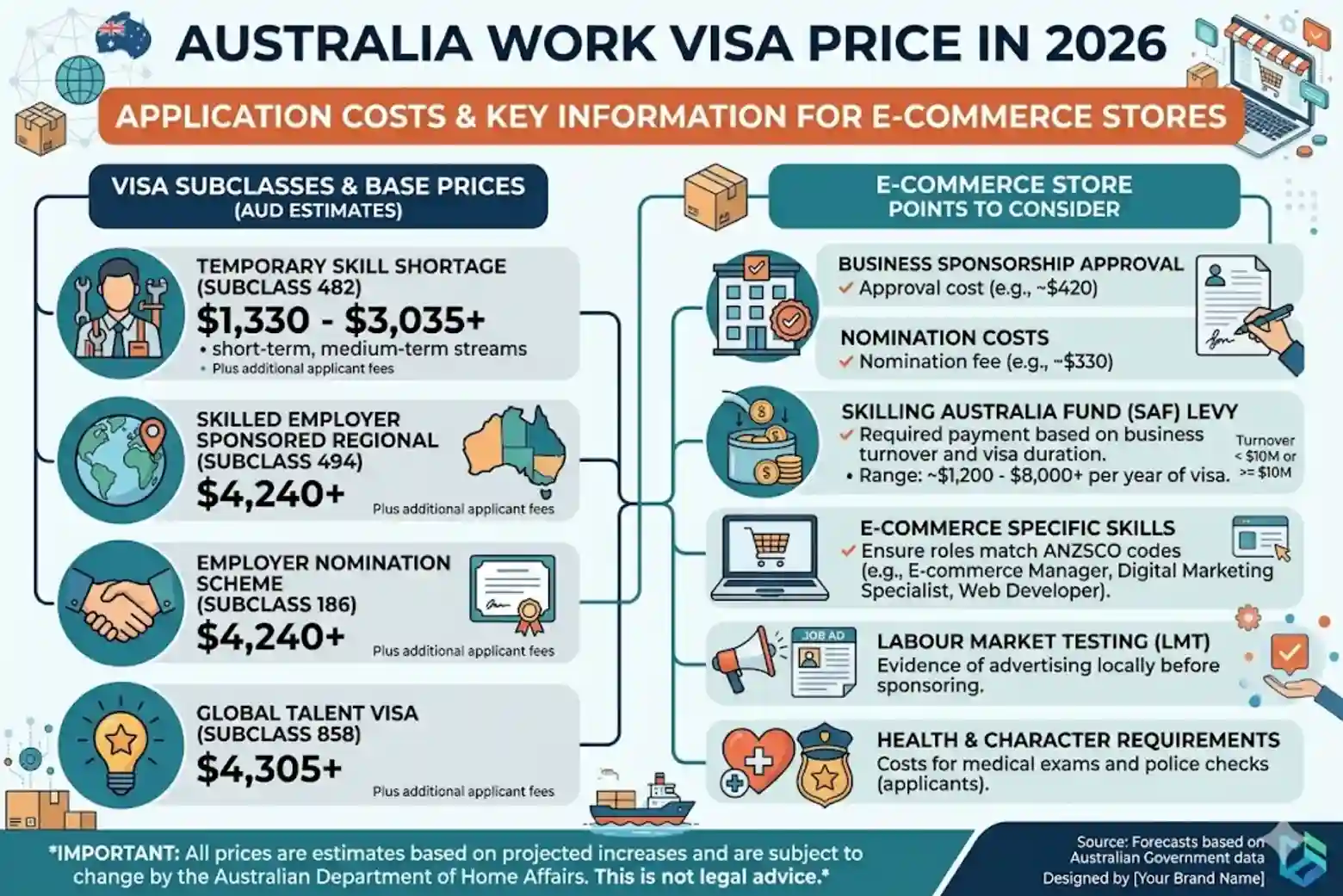
Australia remains one of the most sought-after destinations for skilled workers globally, and with the country’s ongoing labour shortages across healthcare, engineering, construction, and technology sectors, the demand for work visas shows no sign of slowing. Understanding the full Australia work visa price before beginning the application process is essential — not because the fees are hidden, but because there are multiple components across different stages that catch many applicants off guard. This guide covers every cost associated with the most common Australian work visa pathways in 2026, from the base application fee to skills assessments, health examinations, and additional applicant charges.
Quick Answer: How Much Does an Australia Work Visa Cost in 2026?
The Australia work visa price varies significantly depending on the visa subclass. The most commonly used skilled worker visa — the Subclass 482 Temporary Skill Shortage (TSS) visa — costs AUD 3,115 for the primary applicant for the short-term stream and AUD 3,115 for the medium-term stream as the base application fee. Additional costs for family members, skills assessments, health checks, police clearances, and the Skilling Australians Fund levy can push total out-of-pocket expenses to AUD 10,000 or more for a complete sponsored application.
Main Australian Work Visa Subclasses and Their Base Fees
Australia’s work visa system is divided into several subclasses, each designed for different worker profiles — from employer-sponsored skilled workers to independent skilled migrants and working holiday makers. The fees below are the current base application charges set by the Department of Home Affairs for the primary applicant and are denominated in Australian Dollars (AUD).
| Visa Subclass | Visa Name | Primary Applicant Fee (AUD) | Who It’s For |
|---|---|---|---|
| Subclass 482 | Temporary Skill Shortage (TSS) | AUD 3,115 | Employer-sponsored skilled workers |
| Subclass 186 | Employer Nomination Scheme (ENS) | AUD 4,770 | Permanent employer-sponsored workers |
| Subclass 189 | Skilled Independent Visa | AUD 4,770 | Points-tested skilled workers, no sponsor needed |
| Subclass 190 | Skilled Nominated Visa | AUD 4,770 | State/territory nominated skilled workers |
| Subclass 491 | Skilled Work Regional (Provisional) | AUD 4,770 | Workers nominated for regional Australia |
| Subclass 417 | Working Holiday Visa | AUD 635 | Young travellers aged 18–30 (or 35 for some countries) |
| Subclass 462 | Work and Holiday Visa | AUD 635 | Youth from bilateral agreement countries |
| Subclass 400 | Temporary Work (Short Stay Specialist) | AUD 365 | Short-term specialist or highly skilled workers |
These base fees are published by the Australian Department of Home Affairs and are updated periodically. Fees are typically revised upward each financial year (July 1), so if your application spans across the financial year boundary, verify the current rate at the time of lodgement. All figures here reflect 2025–2026 fee schedules and should be confirmed against the official Home Affairs website before submitting payment.
Additional Applicant Fees for Family Members
Most Australian work visas allow the primary applicant to include dependants — spouses, de facto partners, and dependent children — in the same application. Each additional family member attracts a further charge on top of the primary applicant fee. These secondary applicant fees are structured differently from the base fee and vary by age and relationship.
| Applicant Type | Subclass 482 Additional Fee (AUD) | Subclass 186 / 189 / 190 Additional Fee (AUD) |
|---|---|---|
| Secondary adult applicant (spouse/partner) | AUD 1,560 | AUD 2,385 |
| Secondary child applicant (under 18) | AUD 780 | AUD 1,195 |
| Secondary child applicant (18 or over, dependent) | AUD 1,560 | AUD 2,385 |
A family of four — two adults and two minor children — applying for a Subclass 186 permanent employer-sponsored visa would pay AUD 4,770 for the primary applicant, plus AUD 2,385 for the spouse, and AUD 1,195 each for the two children: a combined visa application fee of AUD 9,545 before any other charges are added. This illustrates how quickly costs scale for family applications on the permanent pathways.

The Skilling Australians Fund (SAF) Levy
One cost that is unique to employer-sponsored work visas and often surprises applicants is the Skilling Australians Fund (SAF) levy. This charge is paid by the sponsoring employer — not the worker — but understanding it is important because it directly affects which employers are willing to sponsor and how they structure compensation negotiations.
For small businesses with an annual turnover below AUD 10 million, the SAF levy is AUD 1,200 per year of the visa. For larger businesses, it is AUD 1,800 per year. A Subclass 482 visa granted for four years to a worker sponsored by a large business would therefore attract a SAF levy of AUD 7,200, paid upfront by the employer at the time of nomination lodgement. While this is technically an employer cost, it factors into the overall picture of Australia work visa pricing and is a consideration when assessing the total cost of sponsored migration.
Skills Assessment Fees
Many Australian work visa categories — particularly the independent skilled migration pathways under Subclasses 189, 190, and 491 — require a skills assessment conducted by a relevant assessing authority before an Expression of Interest (EOI) can be submitted through SkillSelect. Skills assessment fees are set by the individual assessing body rather than the Department of Home Affairs and therefore vary by occupation and authority.
| Assessing Authority | Occupations Covered | Approximate Fee (AUD) |
|---|---|---|
| Engineers Australia | Engineering professionals | AUD 500 – AUD 985 |
| AHPRA | Nurses, doctors, allied health | AUD 300 – AUD 1,000+ |
| VETASSESS | Trades, technicians, various professionals | AUD 500 – AUD 900 |
| Trades Recognition Australia (TRA) | Tradespeople, technical workers | AUD 300 – AUD 600 |
| ACS (Australian Computer Society) | ICT professionals | AUD 500 – AUD 540 |
| CPA / CAANZ | Accountants, financial professionals | AUD 400 – AUD 800 |
Skills assessments must be completed and approved before the EOI is submitted. In some cases, the assessment process itself may require submission of additional documentation, certified translations, credential verification, or in some occupations, a practical assessment — each potentially carrying its own fee. Allow sufficient time for this step, as processing times range from four weeks to several months depending on the assessing body and current workload.
Health Examination Costs
Australian work visa applicants and their dependants are typically required to undergo a health examination conducted by a panel physician approved by the Australian Department of Home Affairs. The cost of the medical examination varies by country, physician, and the tests required based on the applicant’s age and occupation.
A standard adult health examination — including chest X-ray and physical assessment — generally costs between AUD 300 and AUD 600 per person when converted from local currency. Additional tests such as HIV testing, TB testing, or specialist referrals may be required based on the applicant’s country of origin or medical history and will add further cost. Children under 11 years of age are not required to have a chest X-ray unless indicated by a physician, which can reduce the cost of their examination slightly.
For applicants coming from countries where panel physician services are operated through dedicated immigration health centres, it is worth booking appointments well in advance as availability can be limited. Once the medical examination is completed, results are submitted electronically to the Department of Home Affairs — applicants do not handle the medical results themselves.
Police Clearance Certificate Costs
Most Australian work visa categories require applicants aged 16 and over to provide police clearance certificates from every country they have lived in for 12 months or more in the past 10 years. The cost of obtaining these certificates varies considerably by country:
- Australian Federal Police (AFP) check: approximately AUD 42 online
- UK Disclosure and Barring Service (DBS): approximately GBP 18 to GBP 38
- Indian Police Clearance Certificate: approximately USD 25 to USD 60 depending on state and processing speed
- Other countries: typically USD $15 to USD $80 equivalent, varying widely by jurisdiction
Applicants who have lived in multiple countries will need separate certificates from each jurisdiction, and some countries require in-person attendance at government offices or police stations, which may add travel cost and time to the process.
Australia is a country that rewards thorough preparation across all aspects of relocation — including understanding the lifestyle and living costs that await after arrival. Travellers and new residents alike benefit from exploring what Australian cities genuinely offer day to day, including things like the best lunch spots in Melbourne, which give a practical sense of what daily life and spending look like on the ground in one of Australia’s most popular cities for skilled migrants.
Total Estimated Australia Work Visa Cost Summary
| Cost Component | Estimated Amount (AUD) | Paid By |
|---|---|---|
| Visa Application Fee (primary – Subclass 482) | AUD 3,115 | Applicant or employer |
| Secondary applicant fees (spouse + 2 children) | AUD 3,120 (approx.) | Applicant |
| SAF Levy (4-year visa, large employer) | AUD 7,200 | Employer |
| Skills Assessment | AUD 300 – AUD 985 | Applicant |
| Health Examinations (family of 4) | AUD 1,200 – AUD 2,400 | Applicant |
| Police Clearance Certificates | AUD 50 – AUD 300 | Applicant |
| Registered Migration Agent (optional) | AUD 2,000 – AUD 6,000 | Applicant or employer |
| Total Estimated Range (excluding agent fees) | AUD 7,785 – AUD 17,000+ | Combined |
These figures represent a realistic combined estimate for a family application on an employer-sponsored pathway. Solo applicants on independent skilled visas without dependants can expect substantially lower totals — typically AUD 5,500 to AUD 8,000 including the visa fee, skills assessment, and medical costs. According to, the Department of Home Affairs publishes the official current fee schedule for all visa subclasses, which should always be consulted before lodging a payment.
Optional Costs Worth Considering
Beyond the mandatory fee components, several optional costs are worth factoring into your budget. Using a Registered Migration Agent (MARA-registered) is not required but is common for complex applications. Agent fees for a Subclass 482 or 186 application typically range from AUD 2,000 to AUD 6,000 depending on complexity and the agent’s experience. For applications involving multiple family members, occupations with complex skills assessment pathways, or applicants with previous visa refusals, professional assistance can significantly reduce the risk of costly errors.
Document translation is another cost that catches some applicants off guard. Academic transcripts, employment records, and identity documents not in English must be translated by a NAATI-certified translator. Translation costs vary by document length and language but typically range from AUD 80 to AUD 200 per document.
For those who have already explored Australia as a tourist or working holiday visitor, the transition to a skilled work visa represents a significant step up in both process complexity and cost. Understanding what Australia offers beyond its major cities is also valuable context — the country’s regional areas are actively courting skilled migrants through the Subclass 491 pathway, and resources covering Australia’s best destinations give a useful geographic overview of where workers are being encouraged to settle.
Frequently Asked Questions
Who pays the Australia work visa fee — the employer or the employee?
It depends on the visa subclass and the agreement between employer and worker. For employer-sponsored visas, the SAF levy is legally the employer’s responsibility. The visa application fee can be paid by either party depending on the employment arrangement. Independent skilled visa fees are always the applicant’s own responsibility.
Are Australia work visa fees refundable if the application is refused?
Generally, visa application fees paid to the Department of Home Affairs are non-refundable once the application has been lodged and assessed, regardless of the outcome. There are limited exceptions where a refund may apply — for example, if the application was never allocated for assessment — but these are uncommon. Always confirm the refund policy before lodging.
How long does it take for an Australian work visa to be processed?
Processing times vary considerably by visa subclass and individual application circumstances. The Subclass 482 TSS visa typically takes between 2 weeks and 5 months. Independent skilled visas (189, 190, 491) depend on invitation rounds and can take 6 to 18 months from EOI submission to visa grant. The Department of Home Affairs publishes current median processing times on its website.
Can I include my family in an Australian work visa application?
Yes. Most Australian work visa subclasses allow the primary applicant to include a spouse or de facto partner and dependent children in the same application. Each additional family member incurs a secondary applicant fee as detailed in the tables above. All family members included in the application must also meet health and character requirements.
The Australia work visa price in 2026 is more than a single application fee — it is a combination of government charges, skills assessment costs, health examinations, police clearances, and in employer-sponsored cases, the Skilling Australians Fund levy. For a solo applicant on a straightforward pathway, total costs can be managed within AUD 5,000 to AUD 8,000. For families applying on permanent employer-sponsored visas with full professional support, the total can exceed AUD 15,000 to AUD 20,000 when all components are included. Accurate budgeting from the outset — using the tables and breakdowns in this guide — ensures that the financial side of your Australian work visa journey is as well-planned as the professional and personal transition that follows.
Related Reading: Price of Visa to America in 2026: Complete Visa Charges and Fee Guide

