





Introduction
Flying with a dog or cat can be surprisingly complicated. The carrier may look perfect online, yet fail to fit under your aircraft seat. That is why choosing one of the best airline approved pet carriers requires more than checking a product description.
Airlines set their own pet-carrier requirements, and those rules can vary by aircraft, route, and cabin. American Airlines, for example, recommends soft-sided carriers and states that they must fit under the seat. Its published soft-sided guideline is 18 × 11 × 11 inches.
There is also no universal certification that makes a carrier approved by every airline. In practice, “airline approved” means that a carrier is designed to meet common airline requirements, but your specific airline still has the final say.
For most travelers, the ideal carrier needs to balance three things: under-seat fit, pet comfort, and secure ventilation. A flexible soft-sided design is often easier to manage than a rigid kennel when cabin space is limited.
What Makes the Best Airline Approved Pet Carriers?
The best airline approved pet carriers are designed around the realities of cabin travel. Your pet needs enough room to remain comfortable, while the carrier needs to slide completely beneath the seat in front of you.
A carrier that is technically close to the airline’s maximum dimensions may still be difficult to use if the aircraft has limited clearance. Under-seat space can differ between aircraft models and even between seating positions.

Soft-sided carriers are particularly useful because their flexible construction can compress slightly when placed under a seat. American Airlines specifically recommends soft-sided collapsible kennels for carry-on pets.
Correct Under-Seat Dimensions
Dimensions are the first thing to check. Several major U.S. airlines use measurements around 18 × 11 × 11 inches for soft-sided carriers, but other airlines have lower height limits.
For example, published 2026 comparisons show Southwest at approximately 18.5 × 13.5 × 8.5 inches and JetBlue at approximately 17 × 12.5 × 8.5 inches.
That difference matters. A carrier that fits comfortably on an airline allowing 11 inches of height may be too tall for a carrier with an 8.5-inch limit.
Good Ventilation
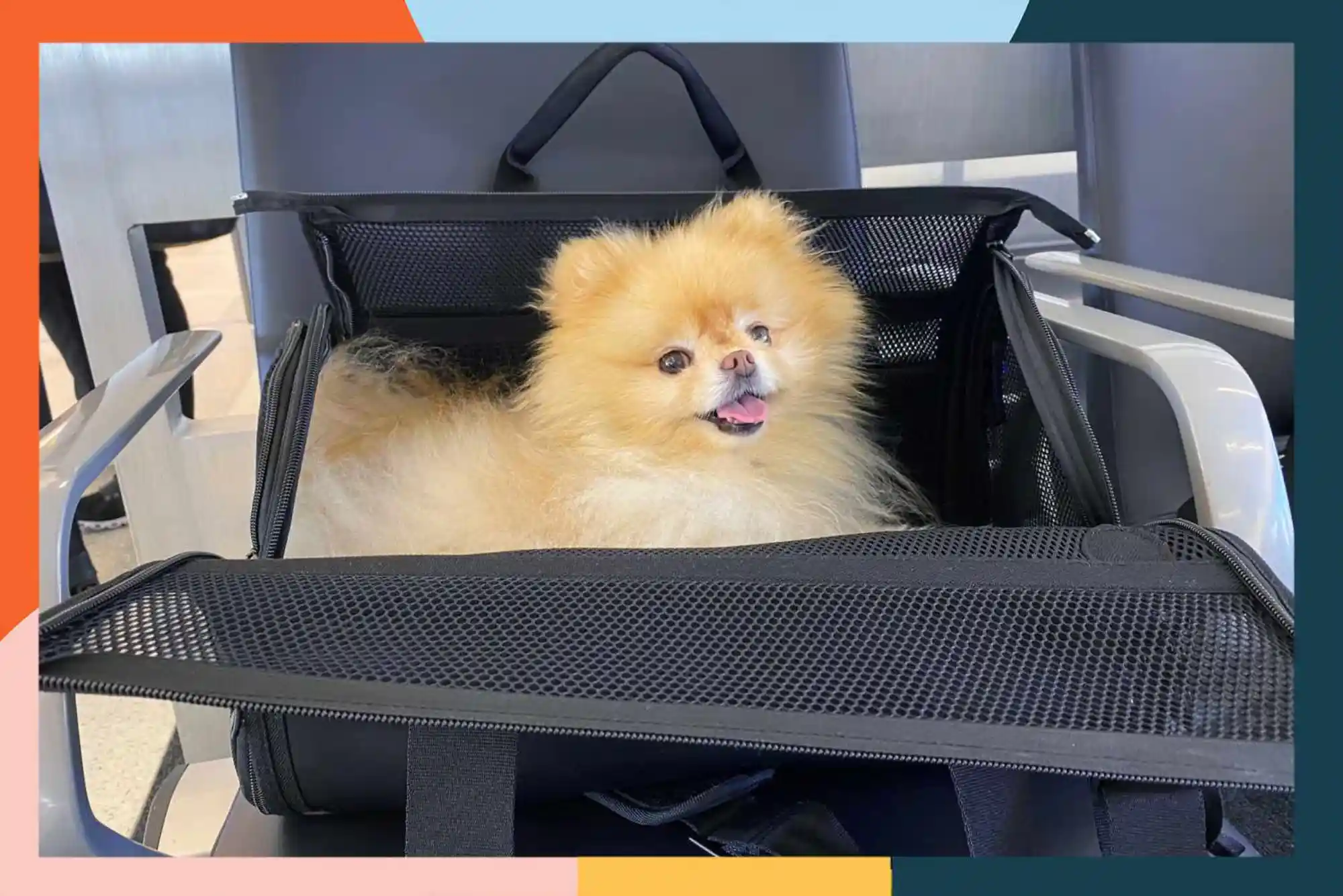
Airflow is another major consideration. Look for generous mesh panels rather than a carrier with only a tiny ventilation opening.
American Airlines requires soft-sided pet carriers to have nylon mesh ventilation on three or more sides.
Multiple mesh panels also allow you to check on your pet without repeatedly opening the carrier.
Secure Closures
A nervous pet can become surprisingly creative when confronted with an unfamiliar environment.
Zippers should close securely and ideally include locking clips or another safety mechanism. The carrier should also have a reliable interior tether when appropriate, although the tether should never restrict your pet’s ability to move naturally.
A Supportive Base
A completely floppy carrier can sag under your pet’s weight. That can make the interior uncomfortable and may make the carrier harder to slide beneath the seat.
A firm but lightweight base gives your pet a more stable surface while still allowing the carrier itself to flex.
Best Airline Approved Pet Carriers for Cabin Travel
There are several well-known carriers designed specifically around in-cabin travel. The right choice depends on your airline, pet’s size, and the amount of under-seat flexibility you need.
Sleepypod Air
The Sleepypod Air is designed specifically around airline cabin travel and has a flexible length that can range from 16 to 22 inches. Its width and height are approximately 10.5 inches, while the manufacturer recommends it for pets weighing up to 18 pounds.
One of its useful features is its ability to compress for different under-seat restrictions. It also has mesh ventilation around the carrier and a relatively structured design.
The important catch is that its maximum length does not mean every aircraft will accommodate it at that length. You should verify the actual under-seat requirement for your flight before purchasing.
Sherpa Original Deluxe Travel Carrier
The Sherpa Original Deluxe is another popular option for cabin travel. Its spring-wire frame allows the rear portion of the carrier to be pushed down, helping it conform to under-seat restrictions. The carrier also includes mesh ventilation, locking zippers, a padded interior liner, and luggage and seat-belt straps.
Sherpa also markets the Original Deluxe as part of its Guaranteed On Board program. That makes it particularly interesting for travelers who want a carrier designed specifically around airline use.
Sherpa publishes aircraft-specific under-seat information for carriers covered by its program, which reinforces an important point: the actual aircraft matters just as much as the carrier’s advertised dimensions.
SturdiBag Pro 2.0
The SturdiBag Pro 2.0 uses a flexible-height design intended to make under-seat fitting easier. The manufacturer says the carrier is designed for in-cabin travel on most major airlines, although its larger sizes may not meet every airline’s requirements.
Its small version measures approximately 18 × 10 × 9.25 inches, making it particularly interesting when height is a concern. Sturdi also uses mesh panels, a padded interior, an interior safety tether, and zipper security clips.
This style can be useful for travelers whose itinerary involves different aircraft because the carrier can flex vertically rather than behaving like a rigid box.
How to Choose a Carrier That Actually Fits Under the Seat
Buying based only on the dimensions printed on a shopping page is one of the easiest mistakes to make.
Start by checking your airline’s current pet policy. Then look at the aircraft operating your flight if the airline provides that information. The published maximum carrier size is not necessarily a guarantee that every seat will provide identical clearance.
Measure Your Pet, Not Just the Carrier
Your pet needs to fit comfortably inside the carrier. A carrier should not be selected solely because it has the smallest external dimensions.
Measure your pet’s body length and standing height. Then compare those measurements with the carrier’s internal dimensions.
The goal is a practical balance. Your pet should be able to remain in a natural position without being squeezed against the carrier’s roof or sides.
Check the Carrier’s Interior Dimensions
Manufacturers often advertise exterior dimensions, but the usable interior can be considerably smaller.
For example, Sleepypod lists exterior dimensions up to 22 inches in length, while its interior length ranges from approximately 15 to 21 inches depending on configuration.
This distinction becomes especially important for cats and small dogs with longer bodies.
Consider the Height First
Height is often the biggest challenge with under-seat carriers.
A carrier measuring 18 × 11 × 11 inches may look like a standard airline size, but an airline with an 8.5-inch height restriction requires a very different design.
If your itinerary includes multiple airlines, check the strictest carrier dimension across the entire trip before buying.
Why Soft-Sided Carriers Usually Work Better
For in-cabin travel, soft-sided carriers have a practical advantage. They can flex when placed beneath a seat without taking up as much rigid space as a hard kennel.
That does not mean you should buy an oversized bag and hope the airline lets you squeeze it into place. Excessive compression can reduce your pet’s usable space and ventilation.
The ideal soft carrier has enough structure to maintain its shape while remaining flexible around the aircraft’s fixed space.
Sturdi’s flex-height system is one example of this approach. The company specifically states that its design helps the carrier adjust beneath airline seats when aircraft dimensions vary.
Comfort Features That Matter During a Flight
Air travel can involve several hours inside the carrier, especially when airport security, boarding, connections, and delays are included.
A padded, washable liner is useful because accidents can happen. Removable bedding is also easier to clean after a long journey.
Mesh windows provide ventilation and allow your pet to see its surroundings. However, some pets become calmer when they cannot see everything happening around them. A carrier with privacy flaps can therefore be useful.
Your pet’s personality matters here. A curious cat may prefer visibility, while a nervous dog may settle better with reduced visual stimulation.
Carrier Safety During Airport Security
Airport security adds another layer to pet travel.
In the United States, travelers generally need to remove the pet from the carrier during screening while the carrier itself goes through the screening process. Because airports can be busy and unfamiliar, make sure your pet has a secure harness or leash before removing them.
Never open the carrier casually in a crowded terminal. A frightened pet can escape extremely quickly.
A carrier with secure zippers, reinforced attachment points, and a comfortable handle makes this process easier.
Common Airline Carrier Mistakes to Avoid
One common mistake is assuming that “airline approved” means approved by every airline. It does not. Airlines establish their own requirements, and those requirements can differ significantly.
Another mistake is choosing the largest possible carrier without checking your pet’s actual measurements. Bigger is not automatically better when the carrier must fit under a seat.
Travelers also sometimes forget to consider connecting flights. A carrier that works for one aircraft may become difficult on another aircraft with less under-seat clearance.
Finally, don’t wait until travel day to introduce your pet to the carrier. Let your pet explore it at home and gradually increase the amount of time spent inside. Familiar surroundings can make the carrier feel less intimidating.
How Airline Policies Can Affect Your Carrier Choice
Airline policies can change, so the carrier you choose should be based on your actual itinerary rather than a generic “universal” size.
Current 2026 comparisons show meaningful differences among major airlines. United, Delta, and American are commonly associated with soft-carrier dimensions around 18 × 11 × 11 inches, while JetBlue and Southwest have lower published height limits.
American’s official policy also notes that soft carriers can be slightly larger than the published under-seat space, provided they can fit without excessive collapsing.
That flexibility is one reason soft-sided models are so common for in-cabin pet travel.
Are Airline Approved Pet Carriers Worth the Money?
A well-designed carrier can be worth the investment if you fly with your pet regularly.
However, the most expensive carrier is not automatically the right choice. What matters is whether the carrier fits your airline’s rules, accommodates your pet comfortably, provides sufficient ventilation, and remains secure throughout the journey.
For occasional travel, a practical soft-sided carrier may be enough. Frequent travelers may prefer a model with stronger construction, washable components, luggage compatibility, and flexible dimensions.
The key is to pay for features that solve an actual travel problem rather than simply paying for a premium label.
How to Prepare Your Pet Before Flying
Preparation should begin several weeks before your flight whenever possible.
Leave the carrier open at home so your pet can investigate it voluntarily. Place familiar bedding inside and reward calm behavior around the carrier.
Gradually practice short periods with the door closed. You can then progress to carrying the pet around the house or taking short car journeys.
Do not wait until the airport to discover that your pet hates the carrier. A few practice sessions can reveal problems while there is still plenty of time to address them.
If your pet has significant travel anxiety or a medical condition, speak with a veterinarian before the trip. Avoid giving sedatives without veterinary guidance.
FAQs
What size pet carrier fits under an airplane seat?
There is no single universal size. Many major U.S. airlines use soft-carrier dimensions around 18 × 11 × 11 inches, while some airlines have lower height limits. Always check the current requirements for your specific flight.
Can I take a pet carrier on a plane?
Many airlines allow small dogs and cats to travel in the cabin when they meet the airline’s pet requirements. The carrier normally has to remain under the seat throughout the flight. Policies vary by airline and route.
What is the best pet carrier for flying?
The best carrier depends on your airline, aircraft, pet size, and travel needs. Models such as the Sleepypod Air, Sherpa Original Deluxe, and SturdiBag Pro 2.0 are specifically designed around in-cabin travel, but you should still verify their dimensions against your airline’s current rules.
How strict are airlines about pet carriers?
Airlines can be strict because the carrier must fit safely beneath the seat. A carrier that is too large may create problems at check-in or boarding, even if the product is marketed as “airline approved.”
Can a pet carrier be slightly bigger than the airline limit?
Some airlines allow soft-sided carriers to exceed stated dimensions slightly when they can fit beneath the seat without excessive compression. American Airlines explicitly describes this flexibility for soft-sided carriers. However, this should never be assumed across airlines.
Can my dog stand up in an airline carrier?
Your dog needs enough space to remain comfortable inside the carrier. Airline requirements vary, but the carrier should never be so small that your pet is forced into an uncomfortable position.
Should I use a soft or hard pet carrier for flying?
For in-cabin travel, a soft-sided carrier is often more practical because it can flex into limited under-seat space. Hard carriers can be suitable where specifically permitted, but their rigid dimensions can make under-seat fitting more difficult.
Choosing the best airline approved pet carriers is really about finding the right match between your pet, your airline, and your aircraft.
Look beyond marketing claims. Check the airline’s current dimensions, measure your pet, compare internal and external carrier measurements, and prioritize ventilation, secure closures, and a supportive base.
Soft-sided carriers such as the Sleepypod Air, Sherpa Original Deluxe, and SturdiBag Pro 2.0 demonstrate different approaches to the same challenge: keeping a small pet comfortable while fitting into the limited space beneath an airplane seat.
Before buying, confirm the rules for your exact airline and flight. Then give your pet plenty of time to become comfortable with the carrier at home.

