






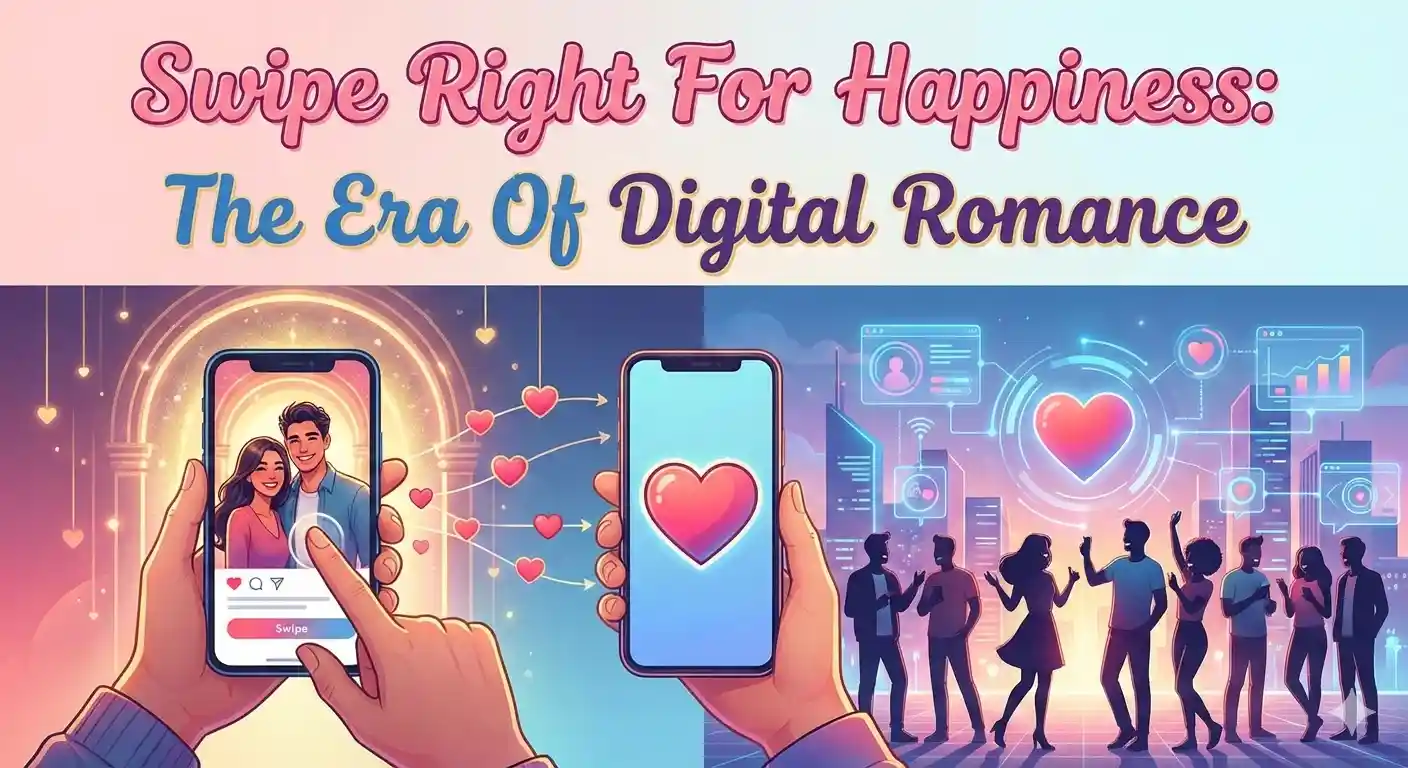
Our grandparents met at dance halls, our parents met at universities and at work, and we open an app on our smartphones and scroll through photos of potential partners while sitting on the couch in our pajamas. Doesn’t sound very romantic? Perhaps. But this is the reality in which millions of people around the world find love, friendship, and simply interesting conversation. Digitalization has changed almost every area of our lives, and romantic relationships are no exception. Moreover, it is in this area that technology has brought about perhaps the most radical transformation, changing the very approach to finding a soul mate.
When the screen becomes a window to a new world
Skeptics like to repeat that technology disconnects people, making us more lonely and isolated. But statistics say the opposite: online dating has become the leading way for couples to form in developed countries. According to research, more than 40% of new relationships begin in the digital space. This is not an anomaly or a temporary trend — it is the new norm.
Why did this happen? The reasons lie not only in technological progress, but also in fundamental changes in our lifestyle. Modern people exist in a mode of multitasking and constant time pressure. Work takes up most of our time, and our social circles are narrowed down to colleagues and a few old friends. Where can you meet someone new? The gym, the grocery store, the commute to work — everywhere, people are busy with their own affairs, closed off in their headphones and immersed in their phones.
Megacities create a paradoxical situation: there are millions of people around, but fewer opportunities to meet someone than in a small town half a century ago. Social norms have also changed. Approach a stranger on the street or in a cafe? Most people will perceive this as an invasion of personal space. What used to be considered normal flirting may now seem inappropriate or even scary.
Online platforms elegantly solve this problem. Everyone here has a common goal—to meet people—so the fear of being misunderstood disappears. You can calmly study profiles, choose people based on interests and values, and start communicating without the risk of public rejection. This is especially valuable for shy people—they have time to think about their response and show themselves in the best light without the pressure of live contact.
Geography is no longer a limitation. You can communicate with someone from another city or even country, find like-minded people with rare hobbies, and expand your horizons far beyond your usual environment. This is especially relevant for people living in small towns, where the choice of potential partners is naturally limited.
From correspondence to live dialogue
Early dating platforms were quite primitive — static profiles, a few photos, and text correspondence. This format opened up new opportunities, but quickly revealed significant shortcomings. Text does not convey emotions, intonations, or a person’s energy. Words can easily create an idealized image that has little to do with reality. How many times has a wonderful virtual conversation ended in complete disappointment at the first meeting?
Video chats were the next evolutionary step that radically changed the quality of online dating. Platforms such as Bazoocam or site like Bazoocam CooMeet.chat offer live communication in real time, combining the advantages of the digital environment with the naturalness of human interaction. This is no longer just an exchange of messages — it is a full-fledged conversation where you can see facial expressions, hear voices, and feel the atmosphere.
The video format solves many of the problems that plagued text-based dating:
- Instant confirmation of a person’s authenticity and that they match their photos
- The ability to read non-verbal communication — gestures, facial expressions, tone of voice
Quick assessment of emotional compatibility and mutual chemistry
Significant time savings before deciding to meet in person
Development of spontaneous communication skills without the ability to edit every word
Psychologists note an interesting fact: video communication involves the same cognitive mechanisms as a face-to-face meeting.
Our brain instinctively analyzes micro-expressions on the face, picks up on emotional nuances, and forms a complex impression of the other person. This makes the acquaintance more comprehensive and reliable, while maintaining the comfort and safety of the digital environment. You can communicate with someone while in a familiar environment, without the stress of a traditional first date.
The pitfalls of digital romance
It would be unfair to talk only about the advantages of online dating while ignoring its dark side.
Technology has created new problems that previous generations never even thought about. One of the most insidious is the effect of endless choice. When dozens and hundreds of attractive profiles float before your eyes every day, consumer thinking kicks in.
The brain starts working in shopping mode: this one doesn’t fit, the next one isn’t perfect either, what if someone better is waiting around the corner? Paradoxically, an excess of opportunities does not make us happier. On the contrary, it breeds chronic dissatisfaction and the syndrome of missed opportunities. People become more picky, less willing to compromise, and constantly doubt their choices.
Swipe culture has turned dating into a conveyor belt of instant evaluations. A person receives a verdict in a matter of seconds based on a couple of photos. This simplifies the process, reducing it to visual appeal. Depth of personality, character, life values, sense of humor — all of this remains invisible until it comes to real communication. And not everyone gets that far.
The problem of illusory images is particularly acute. In the digital environment, it is easy to create an embellished version of yourself: choose the perfect photos, come up with an interesting biography, hide the uncomfortable aspects of your character. Some people become so absorbed in creating a virtual “me” that they lose touch with reality. The first meeting becomes a moment of truth when the masks come off, and this is often painful for both parties.
Researchers also note the psychological risks of active use of dating apps. Addiction to likes and matches, constant comparison with others, painful perception of rejection — all this affects self-esteem and emotional state. For some people, the search for a partner becomes not an exciting adventure, but a source of chronic stress and anxiety.
Wisdom in the age of algorithms
The digital transformation of dating is an irreversible process that will only intensify. Artificial intelligence is learning to match compatible couples with incredible accuracy, virtual reality promises to create the effect of complete presence on dates, and voice and video technologies are becoming increasingly sophisticated. In a few years, first dates may take place in fully immersive metaverses.
But no matter how technology develops, it remains only a tool. True intimacy is born not from compatibility algorithms, but from the human ability to hear, understand, and accept another person with all their imperfections. No app can teach you to love, forgive, compromise, or rejoice in others’ successes as if they were your own.
The key to successful relationships in the digital age is balance and awareness. Use technology as a way to expand your circle of acquaintances, but don’t make it your only channel of communication. Remember that behind every profile is a real person with feelings and vulnerabilities. Don’t be afraid to show your true self, even if it doesn’t always match the ideal image.
Online dating has opened up unprecedented opportunities to find a soul mate. Geography, social circles, shyness — all of these are no longer insurmountable barriers. But success does not depend on the number of swipes or the perfection of algorithms, but on the willingness to be open, sincere, and patient. Love has always been and remains a mystery that cannot be solved by mathematical formulas. It’s just that now we have more ways to find it — and that’s wonderful.
