







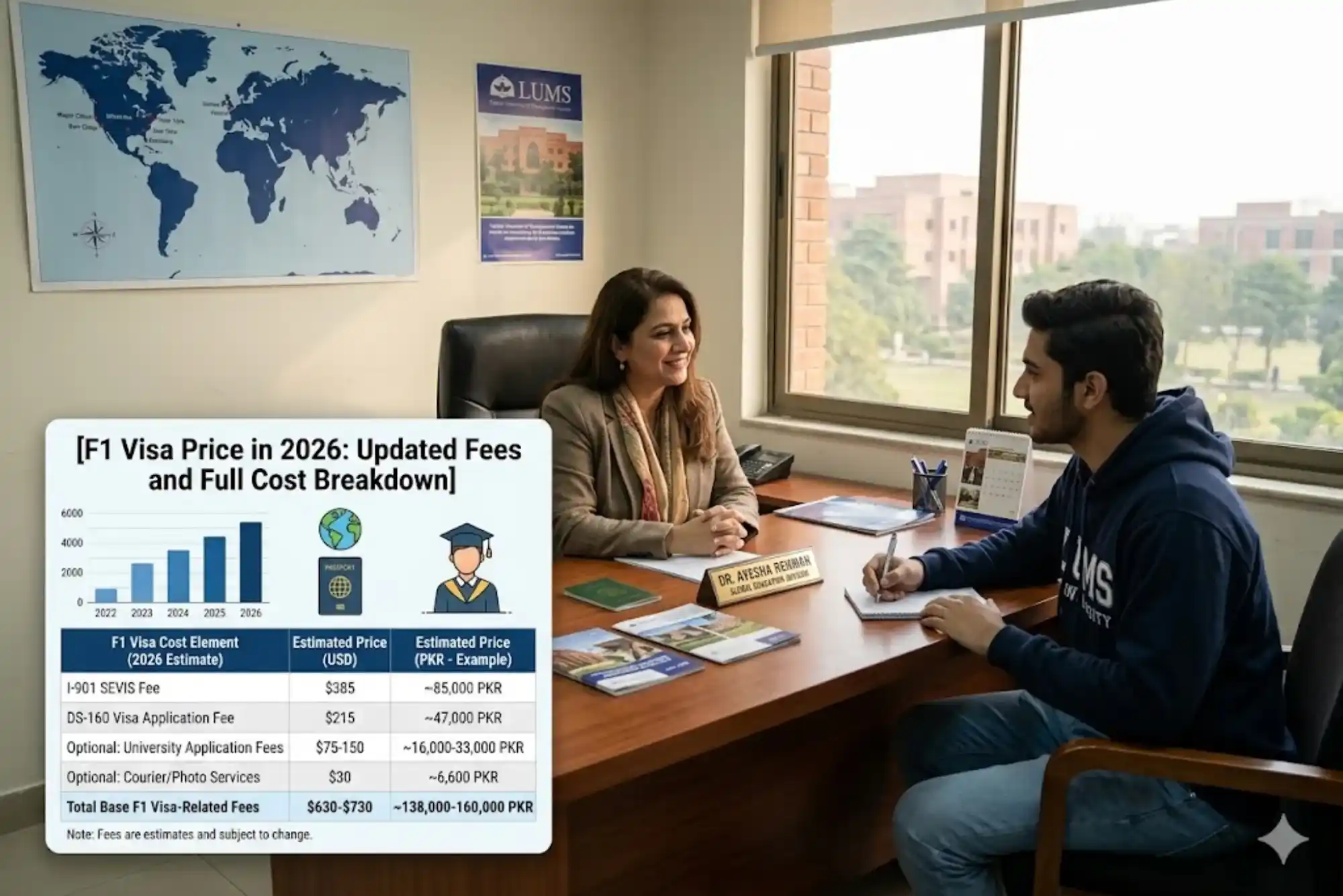
Planning to study in the United States means navigating one of the world’s most detailed visa application systems, and understanding the full cost before you start is essential. The F1 visa price in 2026 is not a single flat fee — it is a combination of mandatory government charges, technology surcharges, biometric service fees, and in some cases additional costs for expedited processing or document services. Getting a clear picture of every fee involved from the outset prevents unpleasant surprises and helps students and their families budget accurately for the full process. This guide breaks down every cost component in detail.
What Is the F1 Visa?
The F1 visa is the primary nonimmigrant student visa category issued by the United States government to international students enrolled in academic programmes at accredited colleges, universities, seminaries, conservatories, academic high schools, elementary schools, and other academic institutions. It also covers language training programmes. The F1 allows the holder to enter the United States for the duration of their academic programme, plus a grace period of typically 60 days after programme completion.
To be eligible for an F1 visa, the applicant must have received an acceptance letter from a Student and Exchange Visitor Program (SEVP)-certified institution, been issued a Form I-20 by that institution, demonstrated sufficient financial resources to cover tuition and living expenses without unauthorised employment, and shown intent to return to their home country after completing their studies.
F1 Visa Price in 2026: Complete Fee Breakdown
The total F1 visa price in 2026 is made up of several distinct fee components, each paid to a different entity at a different stage of the application process. The table below provides an overview of all mandatory charges.
| Fee Component | Amount (USD) | Paid To | When It Is Paid |
|---|---|---|---|
| SEVIS I-901 Fee | $350 | SEVP / US Department of Homeland Security | Before the visa interview is scheduled |
| MRV Fee (Visa Application Fee) | $185 | US Embassy or Consulate | Before scheduling the visa interview |
| DS-160 Online Application Form | Free | US Department of State | At the start of the application process |
| Visa Issuance Fee (reciprocity fee) | Varies by nationality (often $0–$200) | US Embassy or Consulate | After visa approval, before issuance |
| Biometric Services Fee | $85 (where applicable) | US Embassy or Consulate / Application Support Centre | At biometric appointment |
| Premium Processing (optional) | Not available for F1 visa | N/A | N/A |
SEVIS I-901 Fee: $350
The SEVIS I-901 fee is one of the most significant and frequently misunderstood costs in the F1 visa process. SEVIS stands for Student and Exchange Visitor Information System — the US government’s database that tracks international students and exchange visitors throughout their stay in the United States. Every F1 applicant must pay this fee before their visa interview can be scheduled.
The fee is $350 for F1 student visa applicants. It is paid online at the SEVIS I-901 website using a credit card, debit card, or check drawn on a US bank account. Payment must be made using the SEVIS ID number found on the I-20 form issued by the applicant’s US institution. The payment must be completed and confirmed before the applicant can book their visa interview appointment at a US Embassy or Consulate.

The SEVIS fee is non-refundable under most circumstances. One important exception is that if an applicant pays the fee but their visa is subsequently denied, they may be eligible to have the SEVIS fee credited toward a future application within a specific time window — but this credit is not automatically issued and must be requested. Applicants should verify current SEVIS fee credit policies directly through the official SEVIS I-901 payment portal.
MRV Fee (Machine-Readable Visa Application Fee): $185
The MRV fee, officially referred to as the nonimmigrant visa application fee, is the charge paid to the US Embassy or Consulate to process the visa application. For F1 student visas in 2026, this fee is $185. It covers the administrative cost of reviewing the application, conducting the interview, and processing the visa itself if approved.
The MRV fee is paid in local currency through a payment method designated by each US Embassy or Consulate, which varies by country. In many countries, payment is made through a designated local bank, an online payment portal specific to that embassy, or through third-party payment service providers listed on the embassy website. The fee receipt is required to book the visa interview appointment.
Critically, the MRV fee is also non-refundable if the application is denied, withdrawn, or if the applicant fails to appear for the scheduled interview. In many countries, unused MRV fee payments can be applied toward a future interview booking within a specified validity period — typically one year — provided the fee was paid but the interview was never attended. Policies vary significantly by country, so applicants should confirm the fee validity and transfer rules with their specific US Embassy.
Visa Issuance Fee (Reciprocity Fee): Varies by Nationality
Applicants from certain countries are charged an additional visa issuance fee after their F1 visa is approved. This fee is based on the principle of reciprocity — the United States charges the same fee that the applicant’s home country charges US citizens for the equivalent visa. Not all countries trigger this additional charge. Citizens of many countries pay nothing extra at this stage, while citizens of others may pay between $20 and $200 or more depending on the bilateral visa fee arrangement in place.
The US Department of State maintains an up-to-date Visa Reciprocity and Civil Documents by Country resource that lists the current issuance fee for every nationality and visa category. Applicants should check this resource before budgeting to ensure they account for any reciprocity fee applicable to their specific nationality. This fee is paid at the Embassy or Consulate after visa approval and before the passport with the visa stamp is returned.
Biometric Services Fee: $85 (Where Applicable)
Some US Embassies and Consulates require applicants to attend a biometric services appointment where fingerprints and a photograph are collected as part of the visa processing. Where this applies, a fee of $85 is typically charged. However, this fee and the requirement for a separate biometric appointment vary significantly by location. In many countries, biometric data is collected at the visa interview itself without a separate appointment or fee.
Applicants should check the specific requirements of the US Embassy or Consulate in their country when scheduling their interview, as the biometric fee requirement is not universal and is not included in every F1 visa application’s cost structure.
Total Estimated F1 Visa Cost in 2026
| Scenario | Estimated Total Cost (USD) | Notes |
|---|---|---|
| Standard F1 application (no reciprocity fee, no biometric fee) | $535 | SEVIS ($350) + MRV ($185) |
| Standard F1 application with biometric fee | $620 | SEVIS ($350) + MRV ($185) + Biometric ($85) |
| F1 application with reciprocity fee (example: $100 reciprocity) | $635 | SEVIS ($350) + MRV ($185) + Reciprocity ($100) |
| F1 application with all applicable fees | $720+ | SEVIS + MRV + Biometric + Reciprocity (varies by nationality) |
These figures represent the government fees only. Additional costs that many applicants incur — but which are not officially part of the visa fee structure — include document translation and notarisation, travel to the Embassy or Consulate city for the interview, accommodation if travel is required, and any professional assistance fees if the applicant uses an immigration consultant or advisor.
Additional Costs Associated with the F1 Visa Process
Beyond the direct government fees, the F1 visa process involves a range of supporting costs that are easy to underestimate during the planning stage.
Document preparation costs: Bank statements, academic transcripts, financial sponsorship letters, and other supporting documents may require notarisation, official translation, or apostille certification depending on the requirements of the specific US Embassy and the applicant’s home country. These costs range from $20 to $300 or more depending on the volume and type of documents.
Passport and photograph fees: A valid passport is required for the application. If the applicant’s current passport is close to expiry, renewal costs must be factored in. Professional visa photographs complying with US specification requirements typically cost $5 to $20.
Travel costs for the interview: Applicants in countries where only one or two US Embassies conduct visa interviews may need to travel significant distances and stay overnight, adding accommodation and transport costs that can reach several hundred dollars.
Immigration consultant fees: While not required, some applicants choose to work with licensed immigration consultants or attorneys to review their application. These fees vary widely — from $100 for a document review to $500 or more for full application support.
Health insurance and pre-departure costs: US student visa holders are typically required by their institution to maintain health insurance. While this is not a visa fee, it is a mandatory financial commitment that begins at the start of enrollment and should be planned for well before arrival.
For students planning their broader travel to the United States and looking to understand accommodation and destination costs, resources covering hotel prices and accommodation options across US destinations can be useful for budgeting the full transition period, including time spent near the US Embassy for the visa interview.
F1 Visa Fee Exemptions and Waivers
Certain applicants may qualify for exemptions or waivers of specific F1 visa fees. The SEVIS I-901 fee is waived for applicants from countries participating in specific US government exchange programmes, including those sponsored by the US Agency for International Development (USAID) and certain Department of State-sponsored programmes. Applicants in these categories should confirm their exemption status through their sponsoring organisation before submitting payment.
The MRV fee is non-waivable for the vast majority of F1 applicants. No general financial hardship waiver exists for the standard student visa application fee. Some US Embassy-specific scholarship programmes that are fully funded by the US government may include visa fee coverage as part of the scholarship package — applicants should verify this with their programme sponsor.
For students also exploring broader travel experiences and destinations while planning their educational journey to the US, looking into popular places and destinations across the USA can provide useful context for understanding the diverse geography and regions they may encounter as students.
How to Pay the F1 Visa Fees Step by Step
Receive your I-20 form from your SEVP-certified US institution and note your SEVIS ID number.
Pay the SEVIS I-901 fee of $350 online at the official SEVIS payment portal using your SEVIS ID. Keep the payment confirmation receipt.
Complete the DS-160 online nonimmigrant visa application form on the US Department of State’s Consular Electronic Application Center. Print the confirmation page with the barcode.
Pay the MRV fee of $185 through the payment method designated by the US Embassy or Consulate in your country. Obtain the payment receipt or confirmation number.
Schedule the visa interview at the US Embassy or Consulate using your MRV fee receipt number and DS-160 confirmation barcode.
Attend the interview with all required documents, including your I-20, SEVIS fee receipt, MRV fee receipt, DS-160 confirmation, valid passport, and financial evidence.
Pay any reciprocity fee or biometric fee if applicable, as advised by the Embassy at the time of interview or approval.
For the most current and official fee amounts — which are subject to change through US government regulatory updates — applicants should verify all figures directly through the official US Department of State visa fee page and the SEVIS I-901 payment portal before submitting any payment. As a starting point for navigating US government documentation, the provides authoritative current information on all F1 visa requirements and fees directly from the US Department of State.
Frequently Asked Questions
Is the F1 visa fee refundable if the visa is denied?
No. Both the SEVIS I-901 fee and the MRV application fee are non-refundable regardless of the visa outcome. If a visa is denied, the applicant must pay all fees again when reapplying. In some countries, an unused MRV fee may be applied to a future interview booking within a validity period of up to one year — check with your specific US Embassy for details.
Can the F1 visa fee be paid by a sponsor or parent rather than the applicant?
Yes. There is no requirement that the applicant personally pay the visa fees. A parent, sponsor, or financial guarantor may pay the SEVIS and MRV fees on behalf of the applicant. What matters is that payment is completed and confirmed before the visa interview is scheduled.
Do F1 visa fees change frequently?
US visa fees are set by the US Department of State and are subject to periodic revision. The MRV fee has been adjusted several times over recent years, most recently increasing from $160 to $185. The SEVIS I-901 fee has been stable at $350 for F1 applicants for several years. It is always advisable to verify current fees directly through the official State Department and SEVIS payment websites before making any payments.
Does the F1 visa fee cover the duration of the entire student programme?
The F1 visa is typically issued for the duration of the academic programme plus a grace period. The fees paid during the initial application cover the visa issuance for this full period. However, if the visa expires while the student is still in a valid F1 status and they need to re-enter the United States after international travel, a new visa must be obtained with all applicable fees paid again. The visa stamp and the F1 status are legally distinct — status can remain valid even when the visa stamp expires.
The F1 visa price in 2026 starts at a minimum of $535 for most applicants — covering the $350 SEVIS I-901 fee and the $185 MRV application fee — with additional charges depending on nationality-based reciprocity fees, biometric requirements at the specific Embassy, and supporting document costs. Planning for the total rather than the headline fee is what allows students and families to budget accurately and avoid delays caused by unexpected financial requirements during an already complex application process.
Always confirm the latest fees through official US government sources before initiating any payment, as fee structures are subject to regulatory updates without advance notice to applicants. For international students also exploring travel and accommodation planning around their studies, resources covering travel destinations and practical guides across the USA can help make the transition to student life in America as smooth as possible.
Related Reading: US Student Visa Price in 2026: Updated Fees and Complete Cost Breakdown


